I Asked the Night Nurse What the Inflating Boots on My Legs Were For. Her Answer Explained Ten Years of Swollen Evenings.

For about ten years, I had two pairs of legs.
The morning pair was fine. I could see my ankle bones. My sandals buckled on the second hole. I walked the dog around the block and felt like a normal person.
The evening pair belonged to someone else. By six o'clock my ankles were gone, my socks had left a groove you could rest a pencil in, and my wedding ring was stuck until morning. Some nights my legs felt like they were filled with wet sand.
And two or three nights a week, at some awful hour, I'd wake up with a calf cramp so violent I'd yell out loud and wake my husband Dale.
I'm 63. I was a school secretary for 31 years, which means I sat for a living, and I'm retired now, which means I sit even more. I assumed this was simply what legs do after sixty.
It turns out that assumption was the problem.
Everything the doctors told me to do, I did
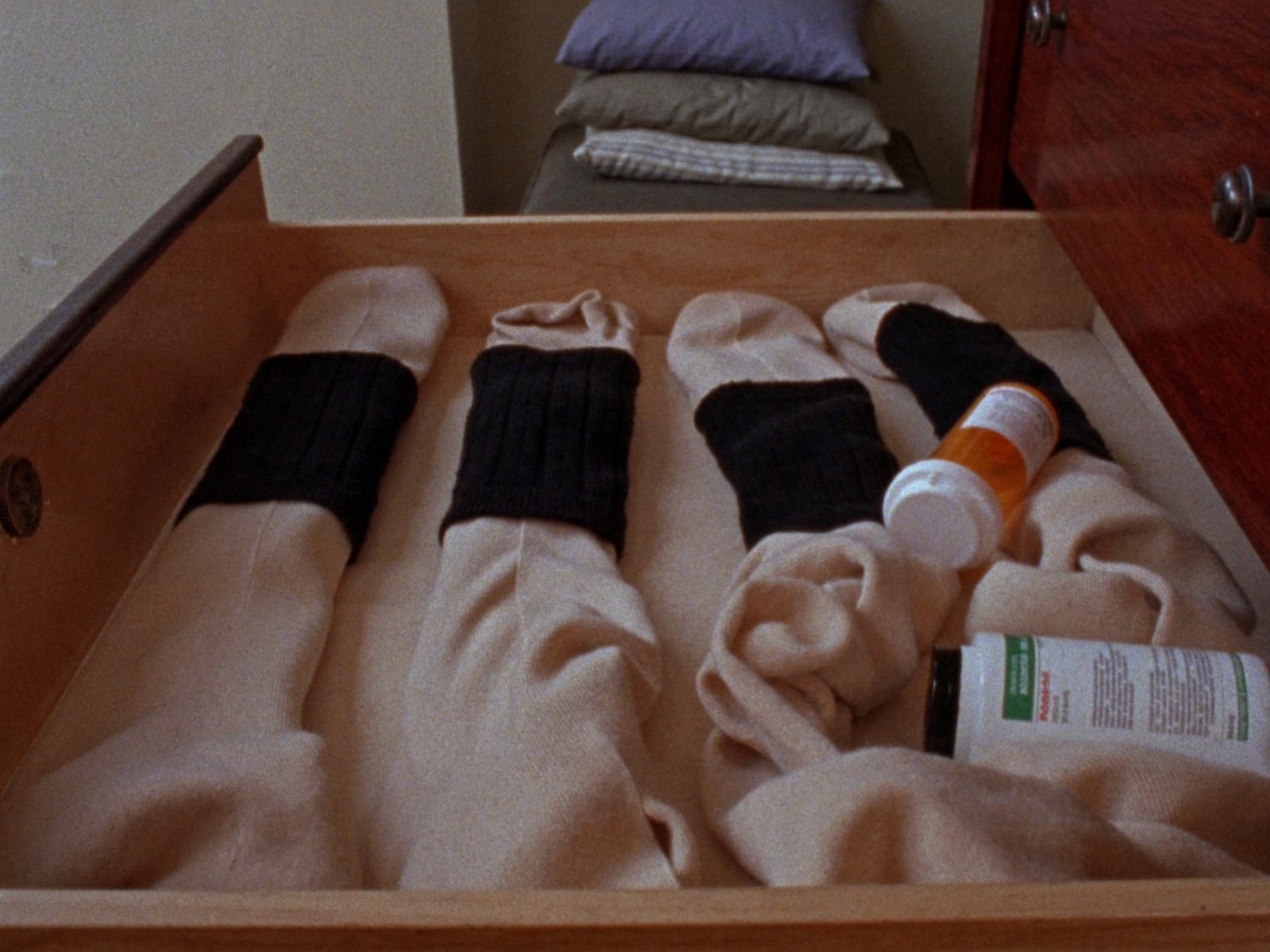
My first doctor said compression socks. I bought four pairs. If you've never pulled on a 20-30 mmHg knee-high with arthritic fingers at seven in the morning, I can't describe it to you — and if you have, I don't need to. They rolled down. They cut a red line under my knee. In a Florida July they were an act of penance. I wore them for about a year and then they went in a drawer.
My second doctor said put your legs up. I did that too. It helped, right up until I stood up. Dale started calling the ottoman "my office." I was spending half my afternoon lying flat to earn a slightly less swollen evening.
Then came the water pill. It worked, in the sense that I was in the bathroom four times a night. And every single morning I'd wake up with normal ankles, and every single evening they'd be back to balloons. The pill drained the water. It never stopped the water from coming. After I read the side-effect leaflet, I quietly stopped taking it.
I took the magnesium, too — the one every YouTube doctor swears by — and the B1, and the potassium. Three months. My ankles didn't read the comments section.
And of course everyone said walk more. So I walked more. I hit 8,000 steps a day for three months. My evening ankles didn't notice.
Every appointment ended the same way — a prescription or a pamphlet, and not one sentence about why. I'd started to believe two things. One, that this was old age and there was nothing to do about it. Two, that if five things everyone recommended hadn't worked, the failure was probably mine.
Both of those beliefs were wrong. I just didn't find out until I had my knee replaced.
The boots they strap on almost every patient in the hospital
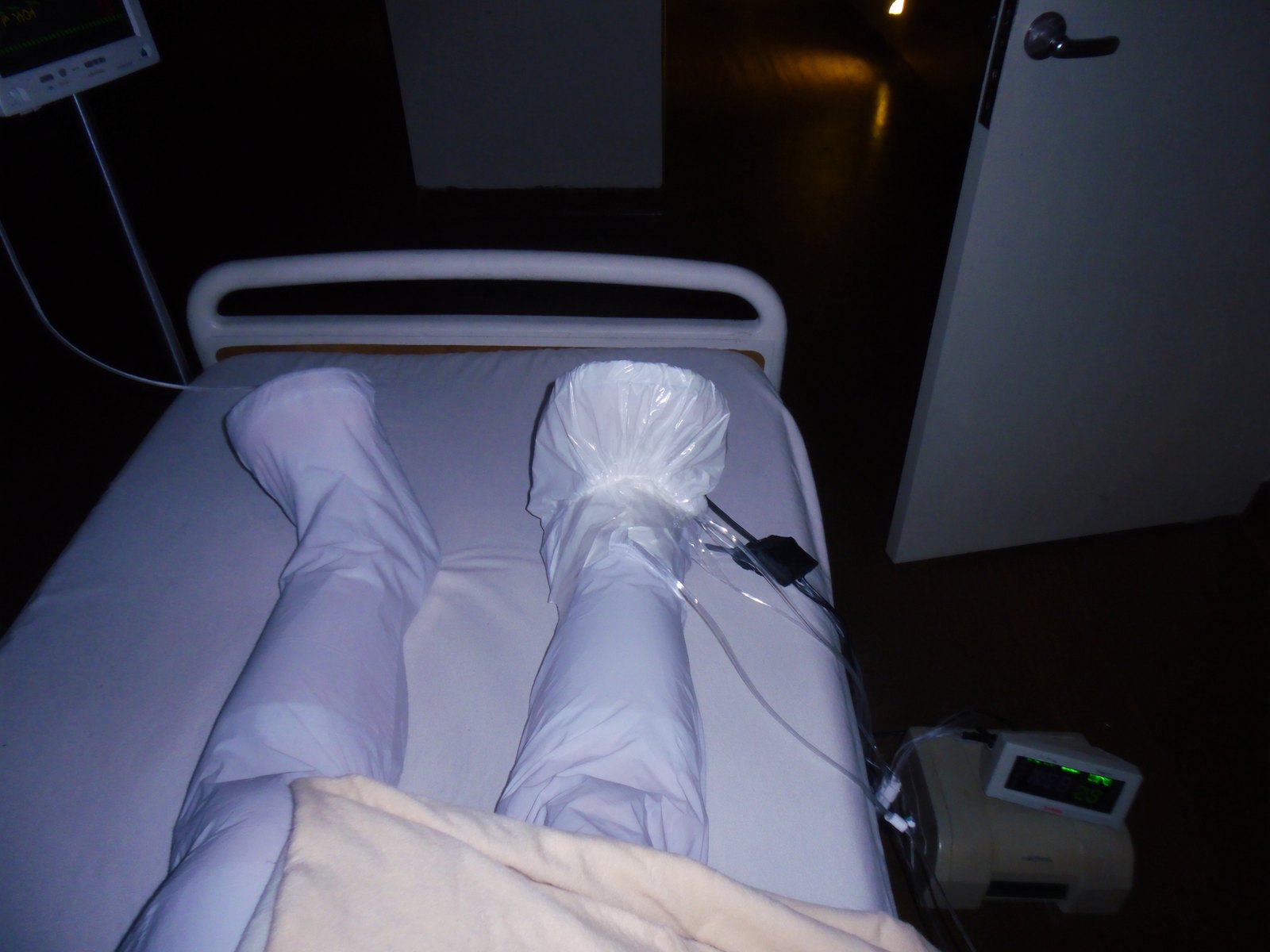
Last February I had my right knee replaced. If you've had surgery in the last twenty years, you may remember what they did the moment I was back in my room: a nurse wrapped both my lower legs in white sleeves attached to a small machine on the floor, and the sleeves started inflating.
At about 2 a.m. I couldn't sleep, and the night nurse, Denise, came in to check my vitals. I asked her what the boots were for.
I expected "it's just protocol." Instead she pulled a chair over and gave me the most useful three minutes of health information I've ever received.
"Your heart pumps blood down to your legs just fine," she said. "But it can't pull it back up. It's too far and it's uphill. Your calf muscles do that job. Every time you take a step, your calf squeezes the veins in your leg and pushes the blood back toward your heart. That's why people call the calf your second heart."
She tapped the sleeve. "Lying in this bed, your second heart isn't beating. So the blood and fluid sit in your lower legs and pool. These boots squeeze your leg from the foot up, one section at a time, and do the pumping your calf isn't doing. We've been putting them on surgical patients since the seventies."
And then I said the thing that changed the next six months of my life.
"Denise — my legs do this at home. Every single evening. Not just in a hospital bed."
She looked at me for a second. "Honey, a lot of you do."
Ten years of swollen evenings, explained in one sentence
I lay awake the rest of that night putting it together, and I want to lay it out the way it finally landed for me, because I've never once seen it explained this plainly.
After about sixty, three things hit the calf pump at the same time. We lose muscle — and the calves go as fast as anywhere. We take fewer steps — retirement, bad knees, Florida heat. We sit for hours — the recliner, the car, the church pew. The second heart doesn't stop. It beats weaker and less often, and gravity wins a little bit more every day.
By evening, the blood and fluid that should have been pumped back up have pooled around the ankles. That's the swelling. The extra fluid weight and the sluggish circulation are the wet-sand heaviness. And the overnight cramps and twitchy, restless legs are what tired, fluid-logged calf muscles do when you finally lie still.
Three complaints. One plumbing problem. Not three separate problems that need three separate remedies. A pump that isn't firing hard enough, and a leg that fills up because of it.
And the moment I saw that, I finally understood why everything I'd tried had let me down — and why none of it had been my fault:
- Compression socks squeeze. One static clamp, all day long. They don't pump. Nothing moves upward because of a sock.
- The water pill drains. It pulls fluid out of the whole body through the kidneys and never touches the calf pump — so tomorrow evening the leg fills again.
- The vitamins feed the muscle. They don't fire it. A well-fed pump that isn't pumping is still a pump that isn't pumping.
- Elevation pauses gravity. The minute your feet touch the floor, it resumes exactly where it left off.
- Walking is the pump. Which is precisely the problem: telling a weakened calf to fix itself by walking is like telling a tired man to feel rested by working harder.
Nothing I'd been given pumped the leg. Nothing. The one thing that did, I'd only ever seen strapped to my legs in a hospital bed, running off a machine I assumed cost a fortune.
Which raised the obvious question I asked Denise before she went off shift: why on earth isn't this in people's living rooms?
Her answer was the second surprising thing I learned that night, and it's the reason I'm writing this at all.
See the home version"They exist. Most people just can't get one."
Denise didn't laugh at my question. She'd clearly heard it before.
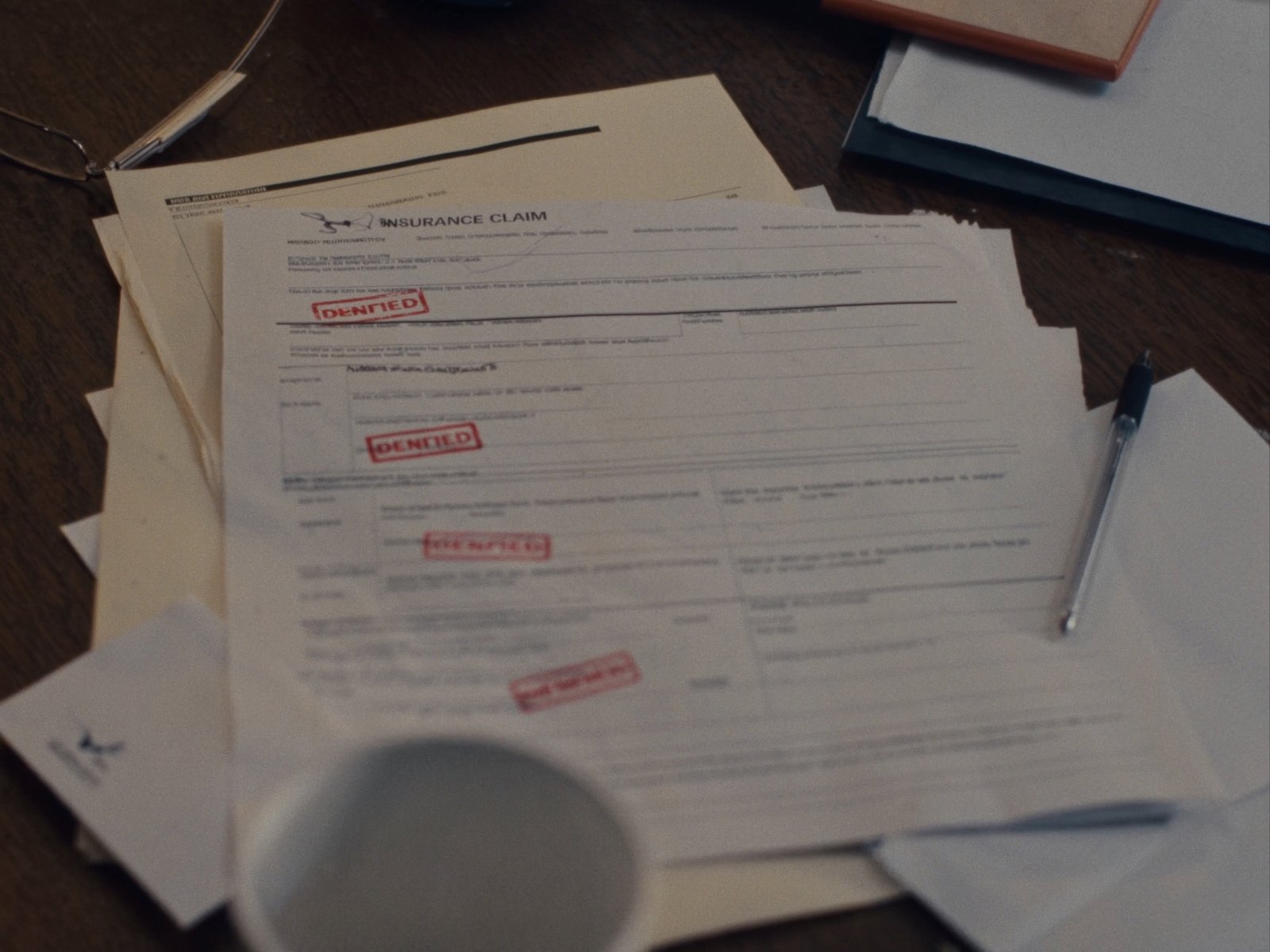
"There are home versions," she said. "Pneumatic compression pumps. Vascular doctors prescribe them. But to get one covered you usually have to fail four weeks of the conservative stuff first — socks and elevation and all of that — and document it, and then the supplier has to get it approved, and then it's billed to Medicare for a few thousand dollars."
I'd already failed the conservative stuff for ten years. I just hadn't filled out a form about it.
When I got home I looked it up, and she wasn't exaggerating. Four-week waiting periods. Denials over a missing form. One woman whose vascular doctor ordered a pump and whose insurance was billed more than $10,000 for it. She'd asked the supplier how it was different from the ones on Amazon, and they "just assured her it was what she needed."
That sentence sent me down a two-week rabbit hole, because I was now certain of two things. The principle was real — real enough that hospitals had trusted it for fifty years. And the principle was simple: a sleeve, some air, inflating from the foot upward in a wave. There had to be a way to get that wave into my recliner without a prescription and a five-figure bill.
What I found — and what I nearly bought instead
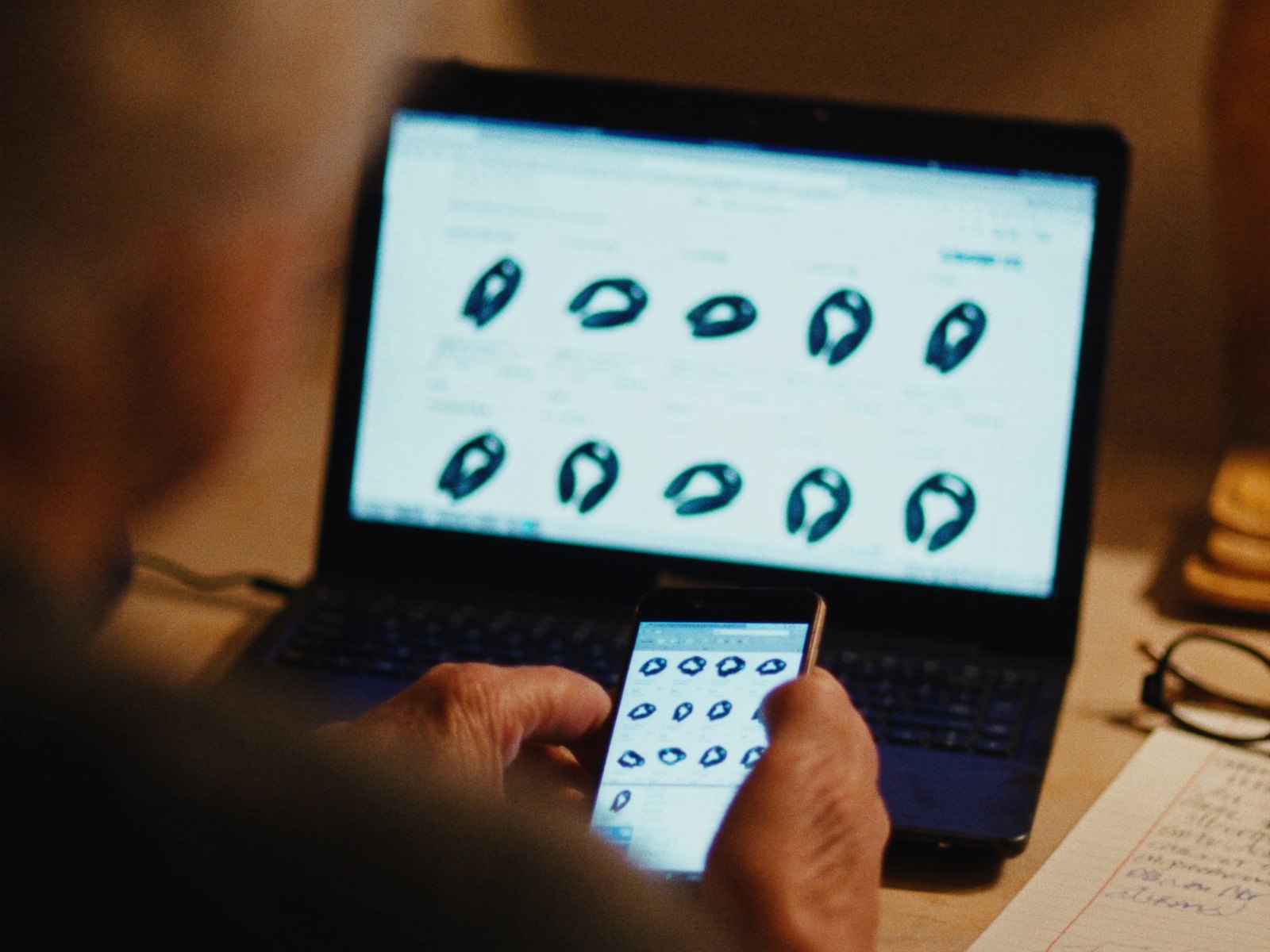
"Leg massager," it turns out, is a very big category, and most of it isn't what Denise strapped on me.
There are foot massagers that vibrate and knead — lovely, and nothing to do with pumping. There are calf sleeves, just the calf, battery-powered, run off a phone app. And there are boots that go higher, at every price from $60 to $900, most of them sold on a phone app and a list of "modes" nobody explains.
Then I started reading the fine print, and found the thing nobody puts in the headline. Most of the cheap boots inflate every chamber at the same time. All at once, then release. That isn't a wave. That's a sock with a motor.
Three other things kept stopping me: reviews about batteries dying after forty-five minutes, reviews about apps that broke after an update, and a woman my age describing a $5,000 unit with a "complicated hookup system" she'd used twice that was now, in her words, "collecting dust."
I didn't want a gadget. I wanted the hospital boots, made for a person who is 63 and wants to press start and sit back.
That's when my daughter, doing her own searching, sent me a link to Sensia Wave.
The hospital principle, built for a recliner
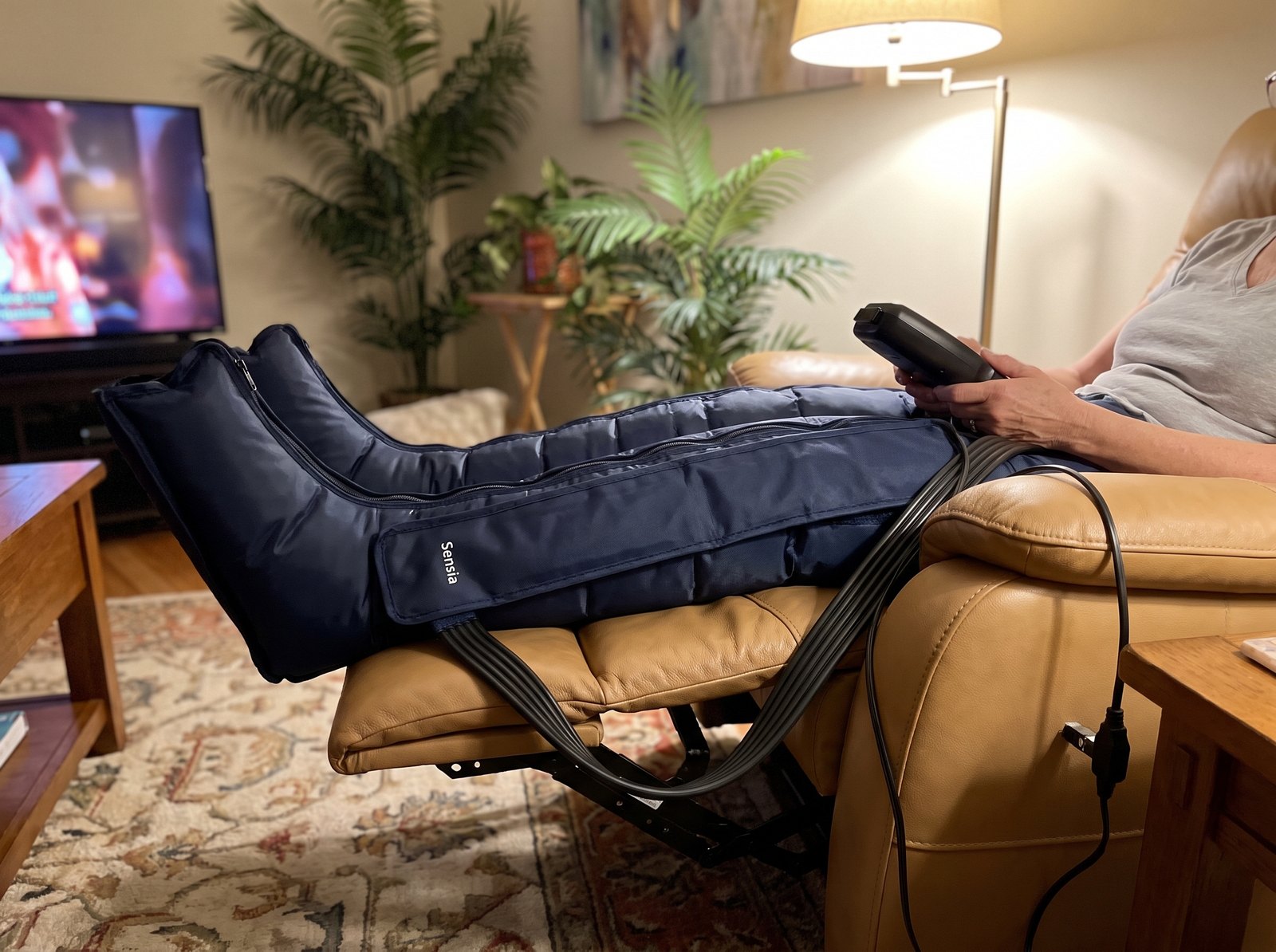
I'll tell you what it is plainly, because that's what sold me.
Sensia Wave is a pair of boots that zip on from your foot to your thigh, with six air chambers stacked up each leg. You plug it into the wall, press start, and the chambers inflate one after another, from the foot upward, then release, then start again. The company's phrase for it is "a wave, not a squeeze" — and after a hospital night watching my own sleeves do exactly that, I knew what they meant.
A sock holds. This moves.
#1 — The wave, not the squeeze
Six chambers, foot to thigh, inflating in sequence — the same direction your calf pump is supposed to push things — then letting go so it can do it again. That sequence is the entire difference between this and every sock I ever owned, and between this and the $60 boots that puff up all at once.
#2 — Foot to thigh, not just the calf
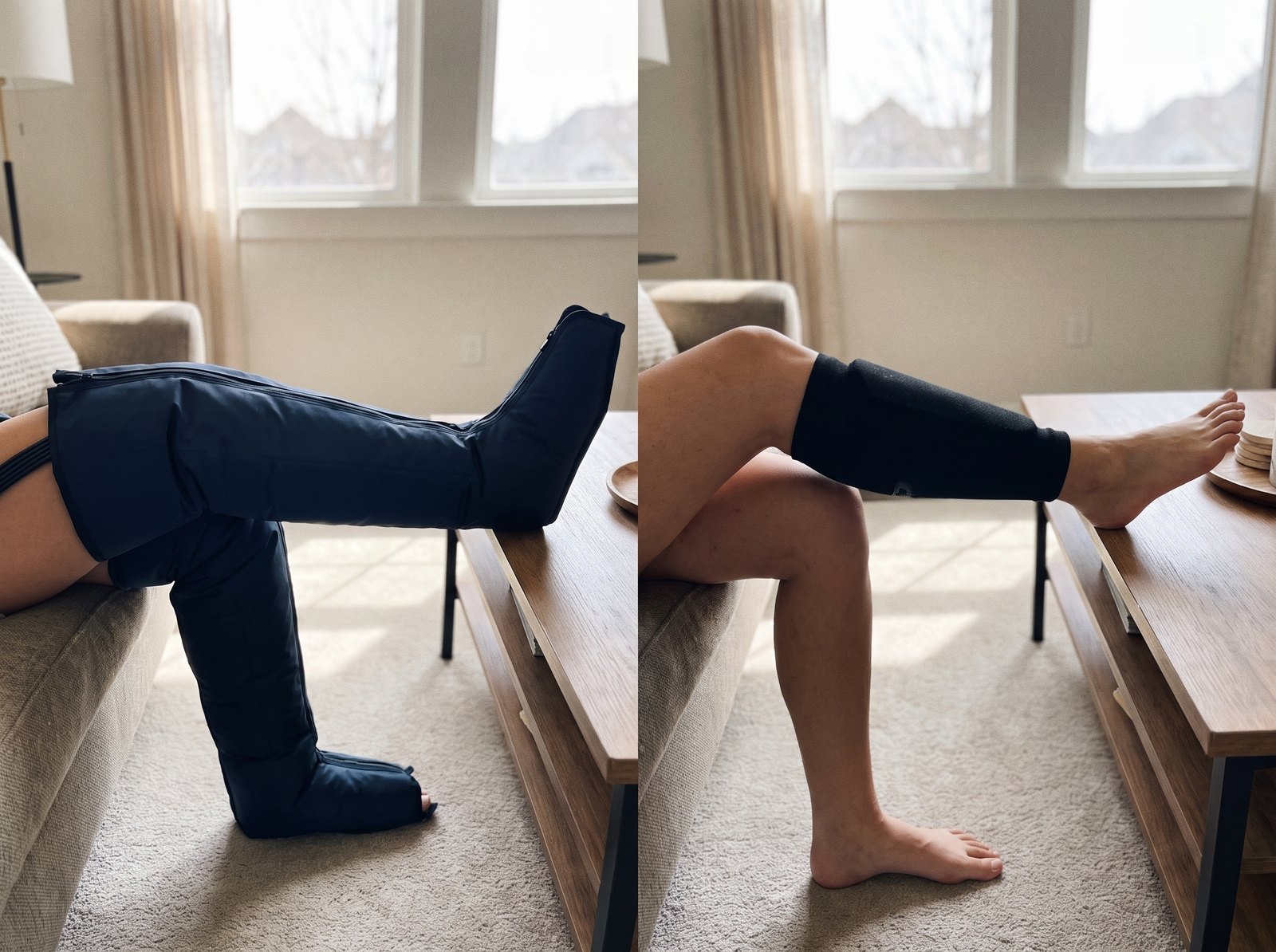
Pooled fluid sits in the foot and ankle first. A calf sleeve starts above the problem. These start where the pooling starts and carry it all the way past the knee.
#3 — Press start. A wall plug. Nothing to break.
Sensia Wave
- Corded — never dies mid-session
- Press start, sit back — the cycle runs itself
- No app
- Gentle starting level
- Inflates in sequence, foot to thigh
Typical "leg massager"
- 45-minute battery
- App updates that break it
- A remote you need the manual for
- All chambers at once
- Collecting dust
A pressure dial with a gentle starting level — which mattered, because I'd read about people hurt by machines that only had "strong." No battery to charge or die. No app. A large-print quick-start card that made me laugh, then made me grateful: I had it on my legs and running within a few minutes of opening the box, without my reading glasses.
And then I sat down for the news.
The first evening
It felt like the hospital. That's the honest answer. The same slow squeeze rising from my foot, the same hiss and release, the same odd relief of feeling something finally move in a leg that had spent the whole day filling up.
When the cycle finished and I unzipped the boots, my legs felt lighter. Not thinner yet. Not fixed. Just lighter — the way they used to feel in the morning. I went to bed at ten.
Nobody in our house yelled that night. Or the next one.
Day fourteen
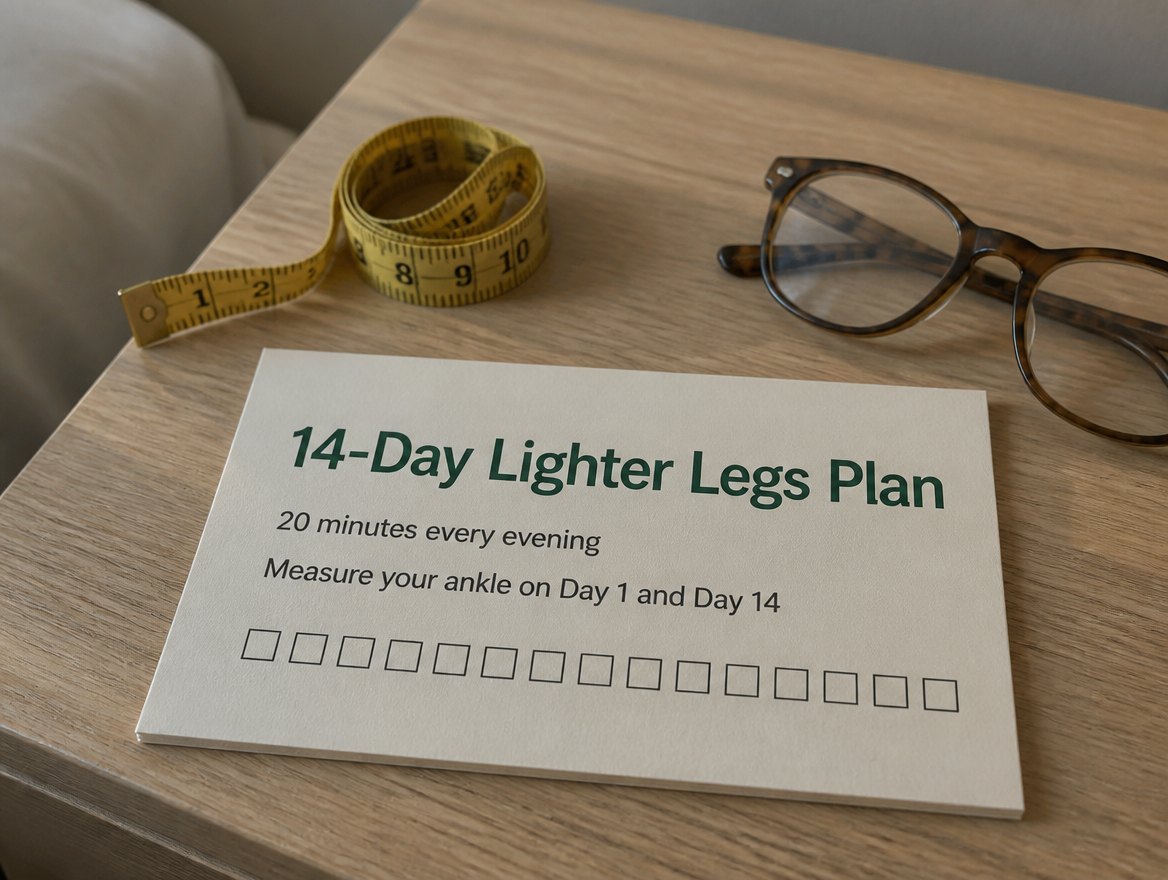
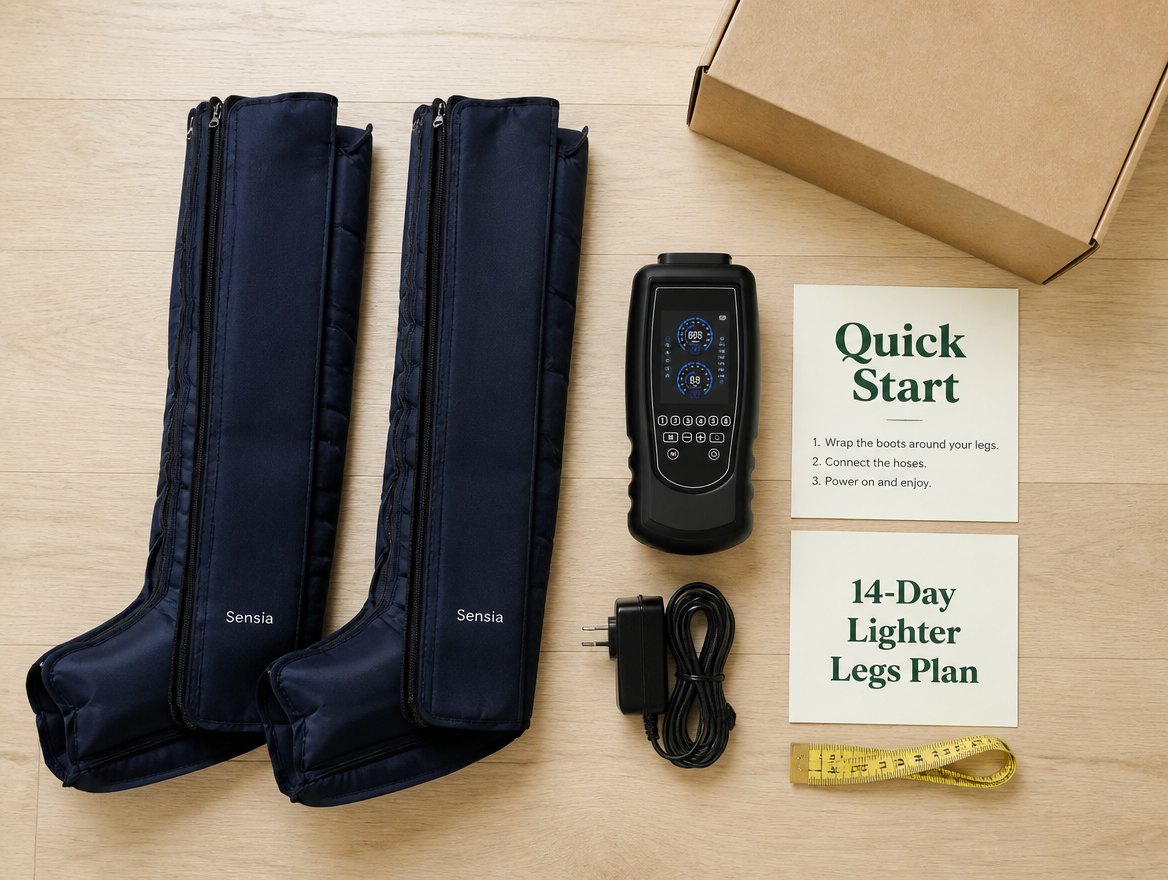
The box included a card called the 14-Day Lighter Legs Plan — really just a schedule: twenty minutes every evening, and a little tape measure to go around your ankle on day one and day fourteen.
I did it. My right ankle measured nearly an inch smaller at six in the evening on day fourteen than on day one. I sat on the edge of the bed, looked down, and could see the bone on the outside of my ankle for the first time in a very long while.
Then I got up and put my sandals on. Second hole.
The 2 a.m. cramps that used to wake Dale? Three weeks in, I'd stopped counting nights, because there weren't any to count.
See the 14-day plan & priceIt's made for anyone whose legs lose to gravity by evening — so Dale's getting his own.
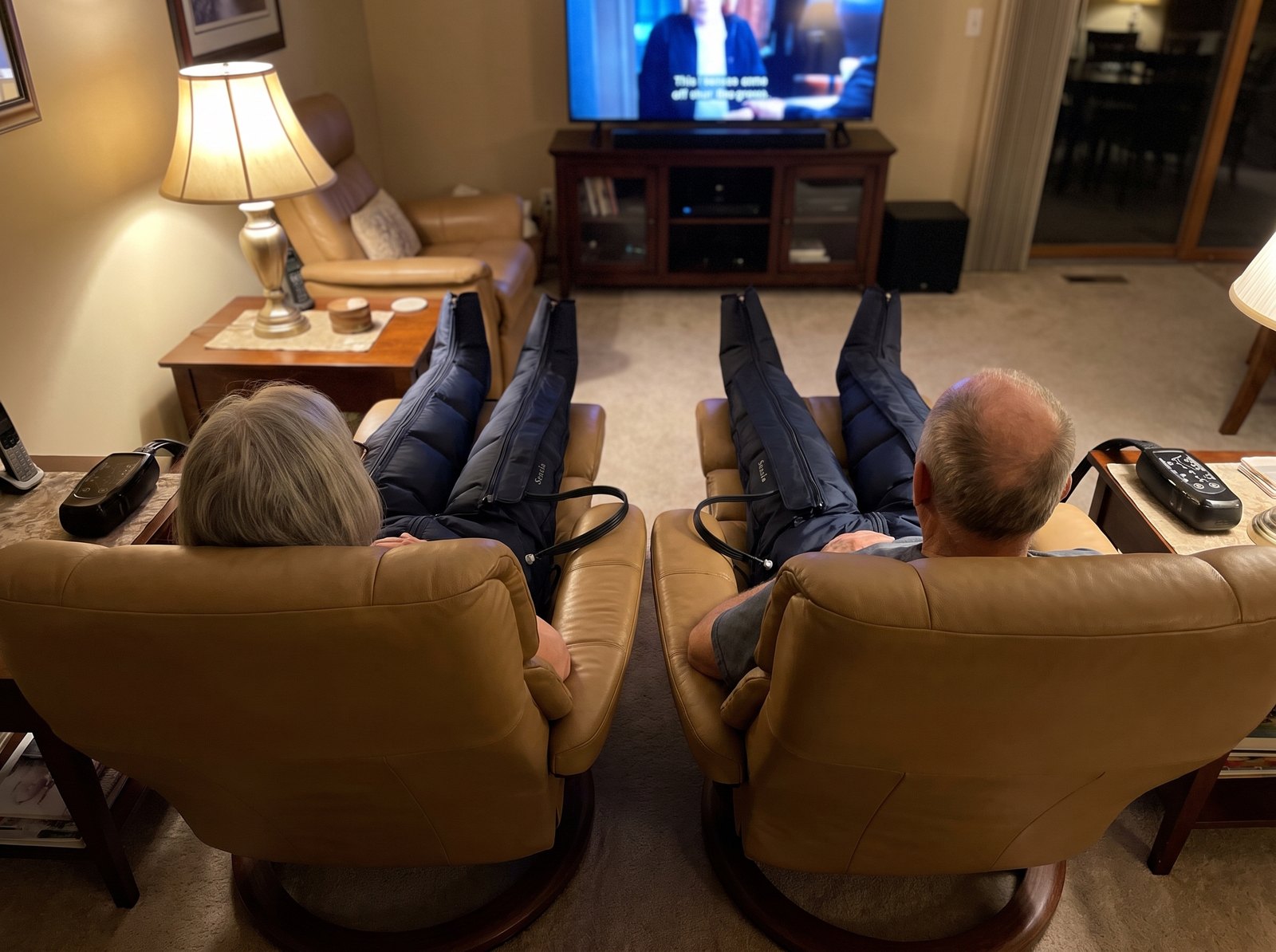
Dale watched me for two weeks and then quietly started asking to "borrow" it. His legs don't swell the way mine did, but he's 66 and by evening they feel like he's been standing in wet cement, and he sleeps better on the nights he gets his turn. The site takes money off a second pair when you order two together, and I suspect I'm not the first wife who's had to give one up.
You don't have to take my word for it — hospitals didn't

"I almost didn't order these. I have a drawer full of compression socks I can't get on anymore with my hands and honestly I figured this was the same idea in a fancier package. It's not. The socks just squeeze and sit there, this thing actually moves up your leg, starts at the foot and works its way up and lets go, over and over. It feels like when they take your blood pressure except on your whole leg. I do it after supper while my husband watches the news. Three weeks in and the main thing I notice is at bedtime my socks don't leave that deep ring around my ankle like they used to. My ring still gets snug on hot days so I'm not going to tell you it's a miracle but my evenings are a lot lighter than they were. Also thank you for the big print card, I didn't need my glasses to set it up."

"My daughter ordered these for me, and I was sure they'd end up in the closet like the massage gun she got me, lol. They didn't. Plug it into the wall, press start—that's it. No charging, no phone app—none of that. The cramps were what I was worried about. I was getting charley horses 2–3 nights a week—bad enough that my wife would wake up. It's been 5 weeks now, and I've had one—maybe two. I do the 20-minute session right before bed. My only complaint is that the hissing sound when it releases the air is louder than I expected; my wife makes me turn up the TV. It's a small price to pay. My legs feel lighter afterward, like they're mine again. Tell your daughter thanks for nagging me."

"I'm a retired RN so I'm skeptical of anything sold online for legs. I ordered mostly because of the 90 days, figured I'd send it back. What sold me was the first night. These are the same idea as the SCD boots we put on post-op patients, I recognized the sequence the second it started, foot then calf then thigh then release. My calves are on the wide side and I was worried about fit, the zipper and the straps had plenty of room. I started on the lowest setting like the card says and went up after a few days. Two weeks isn't long so I'll keep it short: my 6pm ankles are noticeably less puffy, I still get some swelling if I've been in the car all day, and I have not sent it back. One suggestion for the company, tell people to do it before dinner not right before bed, the first couple nights I was up to the bathroom."
So — was it worth $199?
Yes. And I'd have paid it ten years ago if anyone had told me why my ankles swell.
Three things, because I'd want someone to say them to me.
First — nothing you've tried was your fault. Socks, pillows, pills, vitamins, walking: none of them pump. You were handed tools for a job none of them were built to do, and nobody explained the job.
Second — Sensia Wave is not a medical device and not a treatment for any disease. It's the home version of a pumping principle, and that's all it claims to be. If you have a history of blood clots, congestive heart failure or an active leg infection, ask your doctor first — the company lists those right on its FAQ instead of burying them, which is one of the reasons I trusted them.
Third — I had ninety days to send it back. Not thirty. "Lighter legs or your money back" — no form, no argument, they pay the return shipping — plus a two-year warranty on the pump — which, after reading about burnt-out motors and "expensive paperweights," I cared about more than I expected. I'd spent ten years on things that didn't work. Ninety days to find out felt like the first fair deal anyone had offered me.
Gravity doesn't take a night off
The prescription pumps — the ones behind four weeks of paperwork — get billed to insurance for thousands. The athletic-recovery boots you see at gyms run $500 to $900. A single session of professional leg drainage at a clinic is $75 to $150, and you'd need one every evening.
Sensia Wave is $199 from the company's own site — marked down from $299 for its fall sale — or four interest-free payments of about $50, free US shipping, everything in the box: two boots, the control unit, the quick-start card, the 14-Day Plan and the tape measure.
A word about the $60 "compression boots" on marketplace sites: most inflate all their chambers at once. A squeeze, not a wave. The sequence is the whole point — without it you've bought an expensive sock. The 90-day guarantee and the warranty live on the official site, so that's the only place I'd get it.
I'm not going to tell you to buy this. I'm going to tell you what I wish someone had told me ten years ago: the swelling, the heaviness and the cramps are one problem, that problem is a pump, and a sock can't pump. The ankles refill again tomorrow evening whether you do something about it or not. Whether you want the pump in your recliner is your decision.